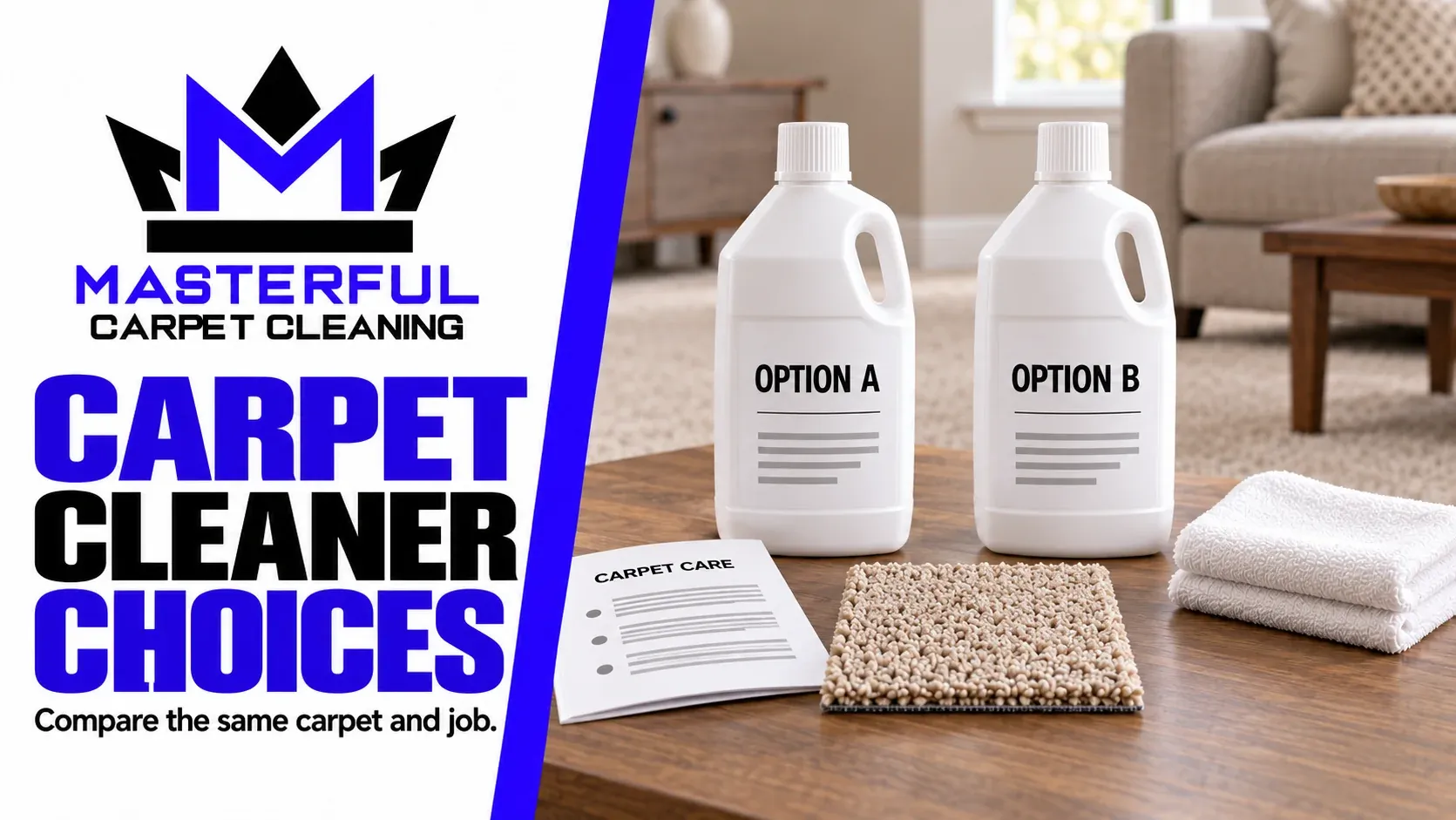
To compare two carpet cleaners, use the same carpet and the same cleaning job. A bottle marketed as “green” and one sold as “traditional” are not two fixed classes of chemistry. Each has its own formula, permitted surfaces, directions and claims. One can fail the carpet’s care requirements before any wider environmental comparison begins.
Identify the installed carpet, the soil or spill and any earlier products. Read the current label for each option and the carpet’s written directions. If you want a professional visit, ask Masterful Carpet Cleaning which cleaning approach is available for that carpet. Ask about the exact product if a particular claim is important to you.
Are the two options solving the same carpet task?
Loose dry grit may need a compatible vacuum rather than a cleaner. An ordinary known fresh spill may first need loose material removed and free liquid absorbed with a clean white cloth. A remaining spot, traffic soil, old dye change and a wet pad are different conditions.
Do not compare bottles against different jobs and call one more effective. The carpet’s care sheet, construction, dye behavior, prior treatment and machine instructions can narrow the choices before a product is opened.
If the carpet has an active leak, contaminated water or continuing wetness, ordinary spot products are not the starting point. Seek an assessment of the water source and affected material. If fibers are worn away or the dye has changed, a cleaner cannot replace the lost material or color. The carpet fiber guide explains why installed material and construction affect a cleaning choice.
Does each product and method have permission for this carpet?
Use the complete current label for Option A and Option B, not the front badge. Find the allowed surface, intended task, dilution, amount, test directions, use with a machine, contact time, rinsing or recovery, drying, ventilation and storage. Compare these with the carpet care sheet and the exact machine manual. If one option is not permitted, set it aside. Check the other option against its own directions before comparing environmental claims.
Use these four checks before comparing marketing claims. Find answers in the product, carpet and machine directions. The US Environmental Protection Agency advises reading household product labels for use and storage precautions. The carpet cleaner label guide explains the individual label checks.
Four checks before comparing carpet cleaners
- Same job. Define the soil, carpet area and result being sought for both options.
- Permitted use. Confirm the installed carpet, cleaner and any machine directions allow each proposed use.
- Complete process. Read amount, test, recovery, drying and occupant access directions for each option.
- Claim and leftover. Identify the exact supported environmental attribute and how unused product is handled.
Do not mix products or borrow a dilution from another bottle. A cleaner that was previously applied may leave residue that changes the next result. Keep a note of the first product, where it went and what changed before any later test.
What environmental claim can each option support?
Ask what “green” refers to: a specified ingredient, packaging, reduced material use, disposal route or another defined attribute. Then ask for evidence and its scope. The US Federal Trade Commission explains that broad environmental claims need clear qualifications and support. One attribute cannot establish that the product and service have a lower total impact across every carpet, stain, machine and room.
EPA Safer Choice assesses ingredients and category performance for qualifying products. You can check an exact current listing in EPA’s product search. That label is more specific than an unidentified leaf symbol, but it is not a carpet style approval or proof of no risk. It also cannot directly rank the labelled product against an unnamed alternative used by a cleaner.
A product derived from plants is not automatically gentle on carpet dye or better for every occupant. A product made with synthetic ingredients is not automatically harsh or inferior. A scent, color, name or generic “safe” slogan does not show how the full formula works on this carpet. Compare exact supported attributes rather than assigning good and bad outcomes to two marketing groups.
Complete the four checks first. Then use the table to record what the labels say for the remaining options, or why one was ruled out. Scroll sideways to read each question and limit. The table asks for your evidence; it does not rate either product.
| Compare for both options | Record from each label or plan | Why the answer changes the choice |
|---|---|---|
| Carpet and machine fit | Allowed carpet surface, product use and compatible equipment. | An unsupported use stops that option for this carpet. |
| Target soil | What each product claims to clean and the required test or preparation. | A claim for a different task does not show a likely result here. |
| Environmental attribute | The precise claim, certifier or test and the scope of its evidence. | One attribute cannot settle the full process comparison. |
| Application and recovery | Amount, concentration, machine passes, liquid recovery and drying directions. | Product plus method affect moisture, residue and room use. |
| Access and leftovers | Ventilation, child and pet access, storage directions and applicable local disposal rules. | Household needs and waste handling may rule out an option. |
How does the full cleaning process change the comparison?
The bottle is only one part. Compare how much is used, if a machine adds liquid or agitation, how soil and moisture are recovered, what remains after the visit, and when the room can be used under the applicable directions. A smaller quantity does not alone establish an equal cleaning result. A water saving statement does not prove that backing or pad dries faster. Room conditions and the installed carpet also affect drying.
The bottle price is only one part of the cost for the same job. Compare the required product amount, compatible equipment or rental, your time and what a professional quote includes.
Compare the complete cost for the same job
- Product amount and price
- Record the purchase price and the amount required by the directions for the same carpet area and task. A cheaper bottle alone does not establish a cheaper job.
- Compatible equipment
- Include any compatible machine rental, purchase or accessories needed to follow the proposed method.
- Your time
- Allow for preparation, application, recovery, equipment cleanup and the directions for using the room again.
- A professional quote
- Compare the included work, spot assessment, cleaning limits and aftercare for that same carpet and job.
Packaging and leftover product may also be relevant, but they need real quantities and a defined comparison. Without that evidence, do not assert a water, energy, carbon, indoor air or cost winner. Ask which attribute a claim measures and which cleaning steps it includes. EPA explains how to identify supported claims for cleaning products and distinguishes ordinary cleaners from antimicrobial products. Neither marketing group automatically disinfects carpet.
Follow each product’s storage directions and applicable local disposal rules. Oregon’s Department of Environmental Quality explains the collection route for qualifying household hazardous leftovers and cautions against pouring those products into drains, soil or stormwater. Not every carpet cleaner qualifies; use the exact product and local guidance. The everyday carpet care guide offers prevention choices between visits, which can reduce the need for extra product attempts.
What if the household has specific concerns?
Read both labels for ventilation, contact, storage and when children or pets may use the area. A “safe for families” phrase does not replace those directions. If a person has a specific exposure concern, use the exact product details in a conversation with an appropriate clinician. For a pet concern, use the exact label and ask a veterinarian. A generic carpet comparison cannot promise symptom relief or zero exposure.
Tell the cleaner about earlier products, a recurring odor, dye transfer, a wet backing concern or a known material limit. Unknown chemistry may require a separate assessment before another cleaner. If a hidden test or a permitted small trial changes color, texture or the mark, stop. A good result on one small area cannot guarantee the entire room will respond the same way.
What should you ask Masterful before a visit?
Share the carpet care sheet if available, photos, the soil and stain history, earlier products, room size and any access concern. Ask which cleaning method and product are available for your carpet. Request the included work, preparation, likely spot limits, moisture recovery, directions for using the room again and aftercare. Masterful can discuss a suitable visit even if neither product on your shelf fits.
If a green claim, named formula or sanitizing treatment is important to your decision, ask which exact product and supported use Masterful offers. Ask what may remain after cleaning. Worn yarn, changed dye and hidden water may need a different assessment.
Common questions about comparing carpet cleaners
Is a green cleaner always gentler than a traditional one?
No. Neither label identifies a consistent chemistry or a result for your carpet. Compare the exact formula’s allowed use, the installed carpet directions and a supported claim for the same job.
Does a Safer Choice label mean the product will remove my stain?
No. The label has specific ingredient and category performance criteria. It does not identify your stain, permit use on every carpet or guarantee removal after previous treatments.
Can I compare two cleaners using only the ingredients on the front?
No. Read the full use directions, permitted surface, application details and local disposal rules. A headline ingredient is not the entire formula or process.
Does using less water always mean a better environmental result?
No universal result follows from one number. Compare the complete process, the soil result and the water recovered, with evidence for the claim being made. Avoid leaving a wet backing or unresolved residue to meet a slogan.
What if neither option fits my carpet?
Do not test a product that conflicts with the carpet’s written care or lacks clear permission. Ask Masterful which cleaning visit fits, and describe the carpet, soil and products already used.