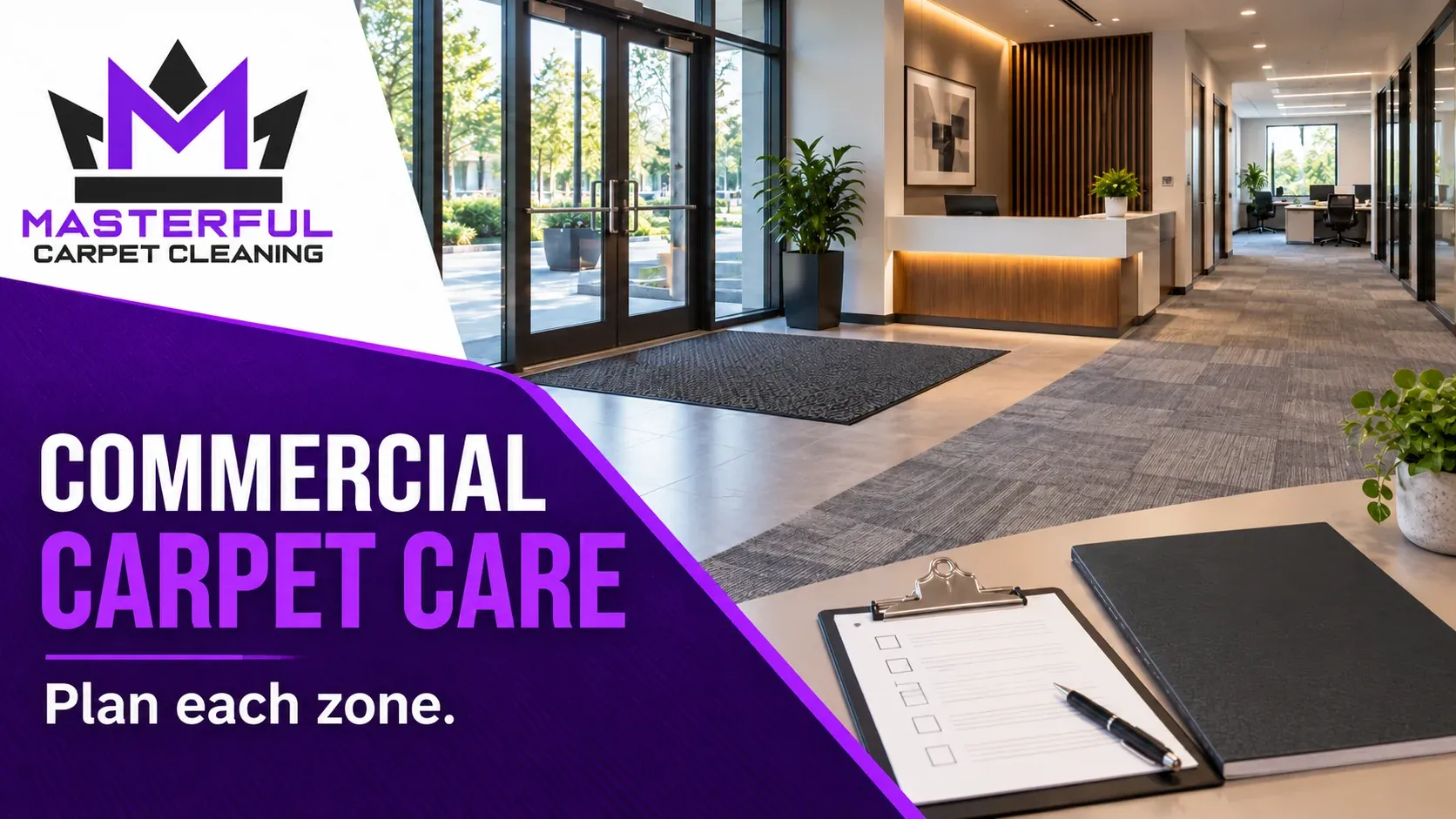
Plan office carpet care around the people and equipment in each zone. Entrances and corridors collect different soil from desk areas and meeting rooms. Map those areas, identify the carpet and care instructions, then agree access, equipment protection, furniture movement and a dry check with the office manager. A written plan makes the scope and the return to use clear.
Go to: map zones · check carpet · plan staff access · protect equipment · move and dry · inspect handback · ask for a scope.
Map entrances, corridors, desks and meeting rooms
Walk the office with a facilities contact. Mark entry mats and reception carpet, corridors, desk clusters, meeting rooms and carpet near kitchens or copy areas. Record traffic, tracked soil, spills, rolling chair wear, carpet tile or broadloom, and the times each space is occupied. CRI 204 commercial carpet guidance distinguishes entrance, corridor, office and meeting room conditions and bases maintenance on use, traffic and maker directions. One interval is unlikely to fit every zone.
| Zone | Carpet and use question | Access or equipment question |
|---|---|---|
| Entrance and reception | Where is soil tracked past the mat, and how is the carpet wearing? | Can visitors use an alternate entrance or route during work and drying? |
| Corridors | Which paths show repeated soil, spills or edge wear? | How will staff reach desks, exits and shared rooms without crossing the work area? |
| Desk clusters | What are the carpet type, chair wear and spots beneath furniture? | Who can move chairs, cables and computer equipment? |
| Meeting rooms | Are there drink spills or marks beneath tables? | Which bookings, furniture and audiovisual equipment limit the work window? |
Check carpet construction and stop conditions
Request the carpet maker’s maintenance instructions, installation records and any product restrictions. Identify fiber, backing, seams, carpet tiles or broadloom, existing damage and old spots. Ask the proposed cleaner to name the product and explain how its label and the maker’s directions fit this carpet. CRI’s commercial standard calls for a plan suited to carpet construction and manufacturer guidance; it does not require one method for every office.
Log a returning stain, persistent dampness or loose tile or seam before work. The manager should resolve an active leak, suspected mold or unknown spill through the property’s own process. Routine cleaning cannot by itself establish that an office is free of allergens or pathogens.
Coordinate staff routes and room closures
Ask a named office manager to approve the work window. Check meetings, shifts, visitor appointments and any staff who need access to a particular room. Agree which doors and routes close, how people will reach exits and essential spaces, where hoses and cords run, and who communicates changes. Keep people out of damp or obstructed zones until the manager completes a return check.
OSHA’s workplace walking surface rule addresses clean, dry workroom floors and passageways free of hazards. It supports planning a clear route for staff; it does not prove that a particular cleaning schedule prevents a fall. If no suitable alternate route or closure is possible, reschedule or narrow the work area.
Protect IT, furniture and adjacent surfaces
Identify computers, monitors, printers, powered floor boxes, cable runs, paper records and movable furniture in the planned area. The office’s IT or facilities owner should decide what can be unplugged, moved or shielded. Record items that must stay in place and carpet beneath them that cannot be reached. Keep products, moisture and equipment away from electronics and adjacent finishes.
Ask the cleaner how it will protect desk bases, partitions, skirting and nearby hard floors. CRI 204 cautions against overspray onto furniture and baseboards. A general promise to protect the office is less useful than a list of items, owners and exclusions agreed before work.
Agree furniture movement and a dry check
List what will move, who is authorized to move it, where it will be stored and who will put it back. Include chairs, tables and portable equipment; leave fixed workstations or powered items to the office’s responsible team. Ask how any carpet under heavy furniture will be handled without assuming it can all be reached in one visit.
Base reopening on a site check rather than a fixed drying time. CRI 204 says cleaning is not complete until the carpet is dry and ready for traffic, and it discusses ventilation during drying. If carpet beneath chair mats is cleaned, agree who removes and replaces the mats; CRI 204 says not to put them back until the carpet is dry. The manager should check carpet, seams, adjoining hard floors and moved items before releasing the space. Do not return furniture to a damp area without confirming the carpet and furniture are suitable for that step.
Inspect the work and record unresolved items
Compare the area with its starting record. Check visible soil or marks, texture, dampness, seams and edges, adjacent surfaces, equipment locations and route clearance. Record anything still wet, inaccessible or damaged and agree who will investigate it. The office manager, not an assumed clock time, should decide when staff may return to each zone.
| Check | Responsible owner and evidence | Hold or reopen decision |
|---|---|---|
| Carpet and seams | Cleaner and manager compare notes on remaining marks, texture, loose edges and dampness. | Keep a damp or damaged area out of use pending another check. |
| Furniture and electronics | Facilities or IT confirms moved items, cables and powered equipment are ready. | Do not assume carpet staff can reconnect or restart office equipment. |
| Adjacent floor and route | Manager checks for moisture, obstacles and usable access. | Release the route only after the site’s check is complete. |
| Unresolved spill or odor | Manager records location and possible source for a separate assessment. | A cleaner appearance does not prove that the source is gone. |
Ask for a written office carpet scope
A broader commercial carpet program covers maintenance choices across a property. This office plan focuses on the rooms, staff access, equipment and return to use for a specific job. Use Masterful Carpet Cleaning’s contact page or call (971) 600-6265 to ask if it currently serves the named office. Share the zone list, carpet details, occupancy window and equipment limits. Request its proposed scope, product and material checks, furniture responsibilities, drying plan, exclusions and price basis in writing. Contact does not establish an office specialist service, an air quality benefit or a guaranteed reopening time.