

A carpet mark that remains after careful first cleaning deserves an assessment before another treatment. Some marks contain removable soil or product residue. Others involve changed carpet dye, worn pile or material beneath the visible surface. Calling every one of these a “deep stain” can lead to repeated water or chemistry that the installed carpet may not tolerate.
A professional carpet cleaning visit can be useful when the remaining material and carpet allow a compatible approach. It cannot put lost color or fiber back, repair a backing, or guarantee that every mark will disappear. This guide helps you decide what to document, when to pause home treatment and what to ask Masterful Carpet Cleaning before a visit.
What “deep cleaning” can mean for installed carpet
For carpet, a deeper professional clean begins with identifying the installed product and the condition of the area. The cleaner considers the pile, dye, finish, backing, care directions, type of soil and products previously applied. A compatible method may loosen or remove material beyond ordinary vacuuming or a first blot, followed by suitable removal of applied liquid and residue.
That does not mean every carpet receives the same machine, heat level, chemistry or amount of moisture. Some products have specific method limits; a stain that has changed the carpet material is a different problem from soil caught among intact yarn. Ask which approach is proposed for your installed carpet and what result is reasonable from the information and any appropriate test.
If a mark is new and free liquid is still present, use the ordinary first spill steps rather than waiting with a wet area. If it remains after initial absorption, the new mark guide covers the next product decision. This page begins when a mark has persisted or earlier treatment complicates the choice.
Look at the mark without guessing its cause
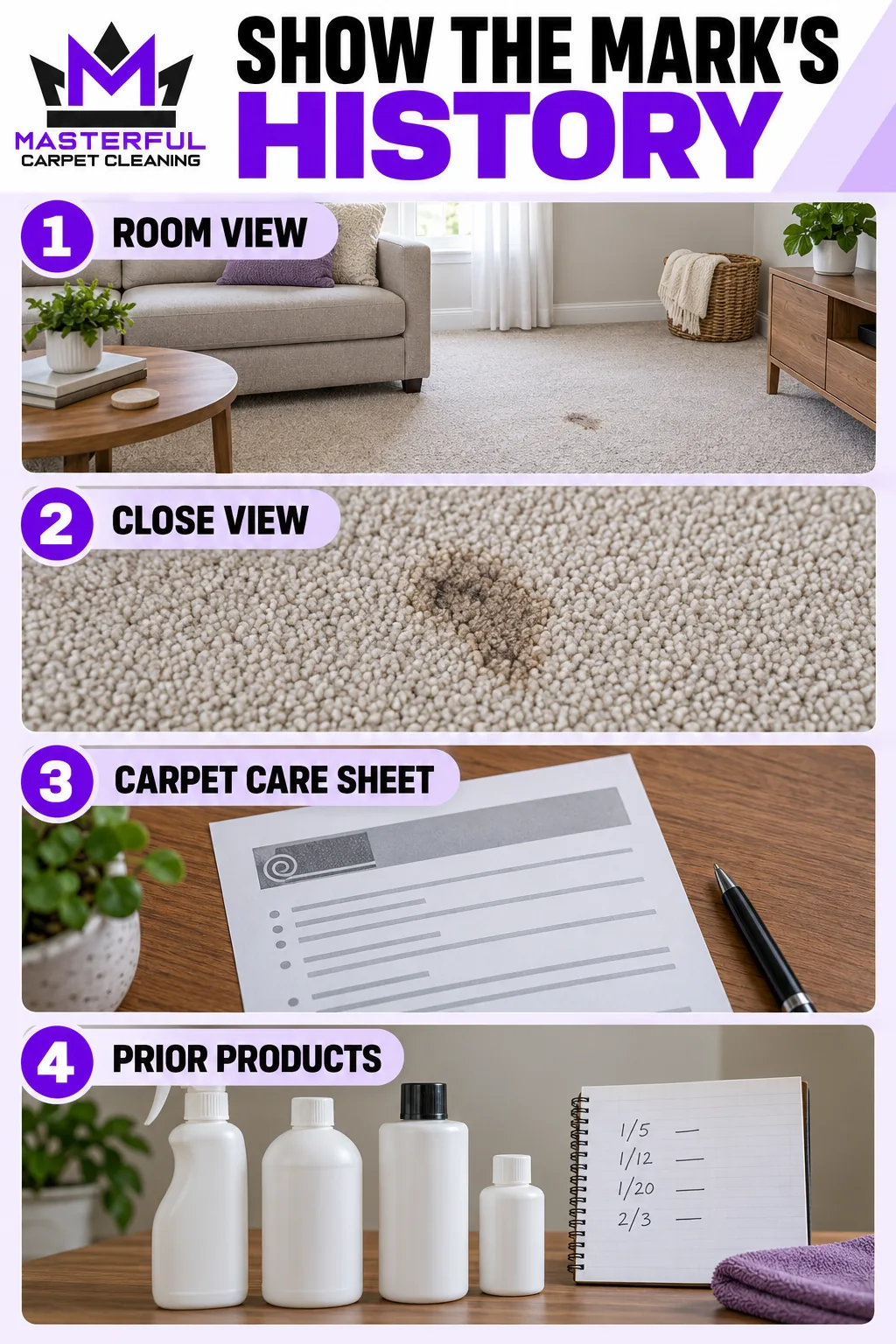
Photograph the mark in ordinary light, including the surrounding carpet for comparison. Note if it feels sticky, looks gray, has lost color, has a changed texture or returns after drying. Record when the mark appeared, what was spilled, and every spot product or machine pass since then. Appearance is useful history but cannot prove what remains in the pile or below it.
Scroll the table sideways to read each condition, useful next step and limit.
| What you notice | Useful next question | Cleaning limit |
|---|---|---|
| Sticky or gray patch with pile still present | Could soil or an earlier product remain, and what was already used? | Appearance alone cannot identify the residue or approve another cleaner. |
| Color different from nearby carpet | Is material on the fibers, or has carpet dye changed or transferred? | Removing soil cannot restore lost carpet dye. |
| Flat, frayed or sparse pile | Did traffic, abrasion, heat or treatment change the yarn? | Cleaning may remove soil but cannot replace worn fiber. |
| Mark or odor returns after drying | Is there residue or a source in backing, pad or another layer? | A clean looking surface does not establish the extent below it. |
| Dampness, spreading or unknown liquid | Is the source still active, or does a separate safety or moisture issue exist? | Routine stain cleaning is not source control or hazardous cleanup. |
A red drink, oily food, ink and pet liquid have different histories even if each leaves a dark patch. Our difficult stain guide explains the stain families. The new and older stain comparison helps when time or previous treatment is the main uncertainty.
Stop home treatment when the carpet gives a warning
Pause if carpet dye appears on a clean cloth, pile texture changes, the mark spreads, a seam loosens, or dampness remains. Also pause if you cannot identify the carpet or the cleaner used earlier. More liquid, scrubbing or a stronger product can add residue or damage without clarifying the cause.
A permitted hidden test has limits. It checks one small place at one moment; it does not prove a larger marked area, old dye or backing will respond the same way. Do not mix an enzyme, solvent, oxygen product or other treatment over an unknown earlier cleaner. Bring the labels and order of treatments to the assessment instead.
If an active leak, contaminated water, suspected mold or wet pad is involved, address that condition separately before ordinary stain cleaning. The US Environmental Protection Agency explains that wet carpet, backing and pad need prompt drying; continuing moisture or suspected mold needs a separate assessment. Routine carpet cleaning should not be presented as mold remediation or a way to confirm hidden layers are dry.
Prepare useful information before a visit
Find the carpet invoice, sample label or care sheet if possible. Note the installed fiber or blend, pile construction and warranty or method limits. If you cannot identify it, say so; do not guess from a photograph. Photograph the room and close view, then list the substance, timing, approximate area and every home or previous professional treatment.
Include the names of products, dilution if known, how long they stayed on the carpet, machine or heat use, and any color transfer. Tell the cleaner if the mark returns after drying, has an odor, feels sticky, lies near a seam, or may reach backing and pad. The sequence of treatments can be as useful as the stain’s age.
Clear access to the affected area and point out other marks on the same carpet. Do not cover the spot with a rug or add fragrance just before the visit; that may hide an observation the cleaner needs. If the source remains active, resolve it first. A cleaner can then discuss a suitable assessment and likely limits before further treatment.
What a suitable professional assessment may involve
A cleaner may identify the carpet and prior chemistry, inspect the affected pile and surrounding area, and choose a limited compatible test when appropriate. If the material appears removable and the installed product permits it, a cleaning method can be selected with attention to soil release, residue removal and moisture recovery. The area is then reviewed after the work and, where needed, after drying.
- Confirm carpet and treatment history
Compare the care directions with the mark’s timeline and every product or machine already used.
- Check for a reason to pause
Discuss dye movement, changed pile, an open seam, persistent dampness or an active source before adding treatment.
- Consider a limited test if suitable
A test may inform one local choice when the carpet and conditions allow it. It cannot predict the whole mark or hidden layers.
- Agree on the likely limits
Ask what method is suitable, how applied liquid and residue would be removed, and what change may remain.
This is a decision aid, not a promise that testing or cleaning is appropriate for every carpet mark.
Each part depends on the carpet and mark. Ask Masterful which approach is available and suitable for your carpet and mark, what the cleaner expects to improve, what may remain, and how the carpet should be used while drying. A mark can become more or less apparent as pile orientation and moisture change, so the first wet appearance is not a final outcome.
Another cleaning pass may help recoverable residue, but it is not always sensible. If testing suggests color loss, worn fiber, a damaged backing or a source below the pile, further surface work may have a limited result. That finding should guide the next choice rather than an automatic repeat treatment.
Discuss the result you need with Masterful
Tell us the mark’s history and the carpet details before booking, especially if it has already been treated. Ask if a compatible assessment or cleaning approach is available for this carpet, how residue and applied liquid would be removed, and what remains uncertain. We can discuss ordinary cleaning for suitable soil; complete removal, carpet repair, pad work and mold work should not be assumed from this article.
If several rooms need service, describe each separately. A traffic lane full of dry soil is a different task from one color change or a wet seam. This helps set a useful visit plan and avoids treating every visible difference as the same “deep clean.”
Ask Masterful about the mark, call (971) 600-6265, or book a carpet cleaning visit when routine cleaning fits the situation.
Common questions about persistent carpet stains
Will a deeper clean remove a set stain?
It may improve removable soil or compatible residue. It cannot guarantee release of absorbed color, replace carpet dye or rebuild worn yarn. The installed carpet, stain history and any appropriate test shape the expectation.
Why did a mark return after cleaning?
Residue, remaining soil, pile direction or a source below the visible surface may be involved. A photograph and treatment history help frame an assessment; the return alone does not prove which cause applies.
Is a second cleaning always sensible?
No. First identify what was applied and how the carpet responded. If dye moved, pile changed or moisture remained, another pass may add risk. Ask about the likely benefit and limits before repeating treatment.
Can a carpet with a wet pad or suspected mold be deep cleaned?
Address the water source and extent first. Routine stain cleaning cannot verify that hidden material is dry or serve as mold remediation. Seek a qualified moisture or material assessment before planning ordinary carpet cleaning.
Is a home machine the same as a professional visit?
Neither a home machine nor a professional method is automatically suitable for every carpet. A visit can include product identification, a review of earlier treatments and a compatible method decision. Ask what Masterful can offer for your installed carpet rather than assuming one machine or result.
How should I prepare for the appointment?
Keep photos, product labels, carpet documents and the order of earlier treatments. Clear access and point out recurrence, dampness, odor, seams or dye transfer. Do not add another cleaner just before the assessment.







