Begin home upholstery care with the furniture tag and its full instructions. The code can narrow the kinds of cleaner to consider, but it does not approve every machine, stain spray or wash cycle. Removing loose dry soil, absorbing a new spill and treating an old mark need different decisions. The visible fabric may also cover seams and filling that should not be soaked.
This guide helps you choose a limited task you can do yourself and recognize when to stop. It does not prescribe one dish soap, solvent or vinegar recipe for every sofa. If you need a fuller explanation of W, S, WS and X, use our upholstered furniture code guide alongside the exact maker directions for your piece.
Find the care tag and read past the code letter
Look on or beneath the piece, under a cushion, or in the purchase paperwork for the upholstery fabric and care instructions. Record the furniture maker, fabric name and code if present. Check if the fixed arms and back use the same fabric as loose cushions. A throw, zippered cover and inner fill can each have separate directions.
The code is a starting constraint, not an approval for any cleaner in that broad category. Some furniture makers restrict hot water extraction or steam on fabrics marked W or WS. Other pieces may have finish, backing or dye limits that the code alone cannot show. If the tag is absent, unreadable or conflicts with a product label, ask before applying chemistry or a machine.
Scroll the table sideways to read the code, possible small task and key limit.
| Common code | What it can help you check | Do not assume |
|---|---|---|
| W | Maker directions may permit a specific water based spot product. | Steam, full extraction or saturation is approved. |
| S | Maker directions may specify a suitable water free spot method. | Any household solvent or dry cleaning kit suits the fabric. |
| WS or SW | Compare the maker’s listed water and solvent conditions with the proposed product. | Every water or solvent method, or a rented machine, is allowed. |
| X | Check the permitted gentle dry soil removal directions. | A liquid, foam or stain spray is an acceptable home step. |
Read the full tag for test location, amount, cleaning area, residue removal and drying. A maker may advise work across a whole panel to avoid a ring, or prohibit a method despite a code that seems to allow its category. Do not expand a small spot attempt into the entire cushion without those directions.
Use a permitted tool for loose crumbs and dust
For loose crumbs or surface dust, use the upholstery tool and suction the maker permits. Move gently across the cover and accessible seams without forcing a brush into the weave. A carpet floor tool can pull a delicate loop or roughen a soft fabric. Stop if threads lift, color transfers or a seam begins to loosen.
A dry cloth or soft tool may be appropriate if the furniture instructions allow it. Collect material rather than grinding it into the seat. Check the tool for residue from another surface before touching the piece. You do not need one weekly timetable for every chair; look at use, visible soil and the furniture care directions.
Vacuuming can remove loose material. It does not remove a liquid held in filling, restore fabric dye or establish that a stain has cleared. A darker patch after vacuuming needs the next decision, not stronger suction by default.
For a known ordinary spill, remove only free material first
If a small household spill lands on accessible upholstery, stop the source if safe. Lift loose solids gently, then press a clean white absorbent cloth onto free liquid without rubbing if the fabric directions permit that first response. Work carefully near piping and seams so the spill is not pushed into the cushion. Note the liquid and timing.
Pause after free material is absorbed. Do not rinse the entire cushion, brush until a ring disappears or apply heat to hurry drying. A cover can look less wet while the filling remains affected. If an unknown or contaminated liquid is involved, do not use this ordinary spot method; seek the right safety or material guidance first.
A washable throw or removable cover has its own label. A zipper does not mean the cover may be taken off, machine washed or dried with heat. Removal can change fit, stitching or backing. Follow the complete instructions for that exact cover before separating it from the cushion.
Check both the furniture and cleaner before a spot attempt
Read the full furniture directions and the proposed product label together. Confirm the fabric, dye, finish, backing and stain are within the product’s permitted use. Follow the directed hidden test if allowed, along with amount, application, removal and drying steps. If either document is missing or conflicts with the other, stop and ask.
Full furniture directions Check the exact fabric, code, cover or panel limits, allowed test and drying method.
Exact product label Check permitted material, test, amount, application, removal and drying.
Use only the shared permitted method. If either set of directions is missing or conflicts, pause before applying the product. A code letter alone does not approve a machine.
A hidden test is limited evidence: it may show an immediate response on one small area but cannot guarantee an old mark, whole panel or inner cushion will behave the same. Work only to the permitted extent. If the maker calls for professional treatment or an entire panel approach, do not replace that instruction with an isolated home dab.
Dish soap, vinegar, alcohol, peroxide, enzyme, baking soda and solvent are not interchangeable upholstery treatments. A household recipe can leave a ring, move dye or affect a finish. Do not stack a second product on top of an unknown first one. Keep labels and treatment notes for a cleaner if the mark remains.
Stop when the fabric, ring or cushion changes
Stop the home attempt if dye appears on the cloth, fabric texture changes, a ring spreads, stitching loosens or the cushion stays damp. A persistent odor can indicate material outside the visible spot, but its source cannot be located from the surface alone. Repeated wetting may make that question harder to resolve.
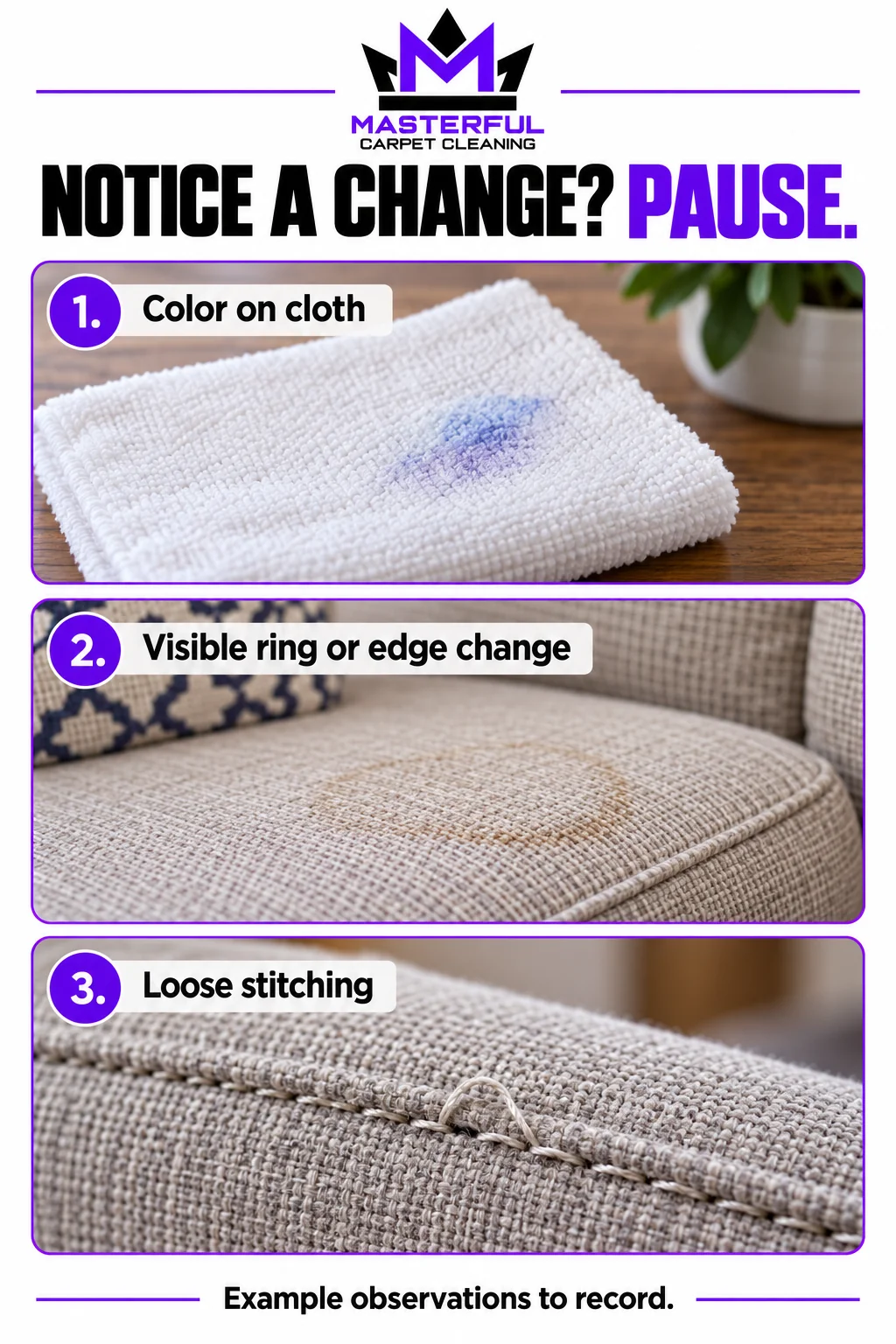
- Stop treatment Pause for dye transfer, a spreading ring, changed texture, loose stitching or continuing dampness.
- Record the history Note the spill, earlier products, machine passes, heat and when each step happened.
- Ask about the piece Share the tag and photos of the affected area so a cleaner can discuss what may be suitable and what may remain.
A surface view cannot locate an odor source or prove the inner filling dry. Another product cannot restore lost dye or repair a seam.
An old or previously treated mark needs its history recorded before another method. Note every product, machine pass, heat application and approximate date. A spill that reached the cushion filling may need a different assessment from one held at the cover. Cleaning cannot replace lost fabric color, mend a torn seam or guarantee that the filling is clear.
If the furniture is used by pets, follow any product label restrictions on access to the treated area. Our upholstery care guide for homes with pets covers fur, cushion incidents and service preparation without turning a fabric code into a pet safety claim.
Share the tag and treatment history with Masterful
Send photos of the whole item, tag and affected panel, plus the fabric or maker name if known. Say if the cover has separate instructions, a zipper or a removable fill. Describe the source, size and age of a mark, any odor or cushion dampness, and every previous cleaner or machine. This helps us discuss the piece rather than assuming all upholstery takes one treatment.
Ask which upholstery cleaning approach is available and compatible with the item. Ask what part can be cleaned, how residue and moisture would be managed and what may remain. A suitable visit can improve some soil or residue, but it cannot guarantee stain or odor removal, restore dye, repair a seam or confirm hidden filling is dry from a surface view.
Contact Masterful or call (971) 600-6265 to discuss the furniture before booking. Our upholstery service page gives the general service context; confirm the exact piece and current appointment options.
Common home upholstery cleaning questions
Does a W code let me rent a steam machine?
No. A W code can be a starting clue for certain water based spot products, while the maker may still prohibit steam, extraction or saturation. Read the exact furniture directions before choosing equipment.
Can I machine wash a zippered cushion cover?
Only if the cover and furniture instructions explicitly permit removal and washing. A zipper alone does not grant that permission or settle shrinkage, backing and fit risks.
Should I spray the whole cushion if a small spot leaves a ring?
Do not expand the treatment on your own. Check if the maker directs an entire panel method or professional care, and record what was applied. More spray can affect the cover and filling.
Can I dry upholstery with a fan or hair dryer?
Follow the furniture and product directions for drying. Heat or moving air is not a universal fix for a cushion holding too much liquid, and a dry surface does not prove the filling is dry. Ask for an assessment if dampness persists.
Can another cleaner remove an old mark?
Possibly, if the fabric and previous chemistry permit it. First identify earlier products and any dye or texture change. Another bottle cannot restore lost color or repair material damage.